
Provider-Level Variation Drives Anti-Streptococcal Coverage for Non-Purulent SSTIs in the Veterans Affairs Healthcare System
Research by Christian Dalton1,2,4, Jamie Rhoads1,3, Atim Effiong1,2, Tina Willson1,2, and Vanessa Stevens1,2
1IDEAS Center of Innovation, VA Salt Lake City Health Care System, Salt Lake City, UT, US; 2Division of Epidemiology, Department of Internal Medicine, University of Utah School of Medicine, Salt Lake City, UT, US; 3Department of Dermatology, University of Utah School of Medicine, Salt Lake City, UT, US; 4Department of Population Health Sciences, University of Utah School of Medicine, Salt Lake City, UT, US
Skin and soft-tissue infections (SSTIs) are common outpatient conditions in the Veterans Affairs (VA) healthcare system. For non-purulent SSTIs, clinical guidelines recommend antibiotics targeting streptococci for mild–moderate cases; however, diagnosis codes alone can combine purulent and non-purulent infections, making it difficult to assess whether prescribing aligns with guidance at scale.
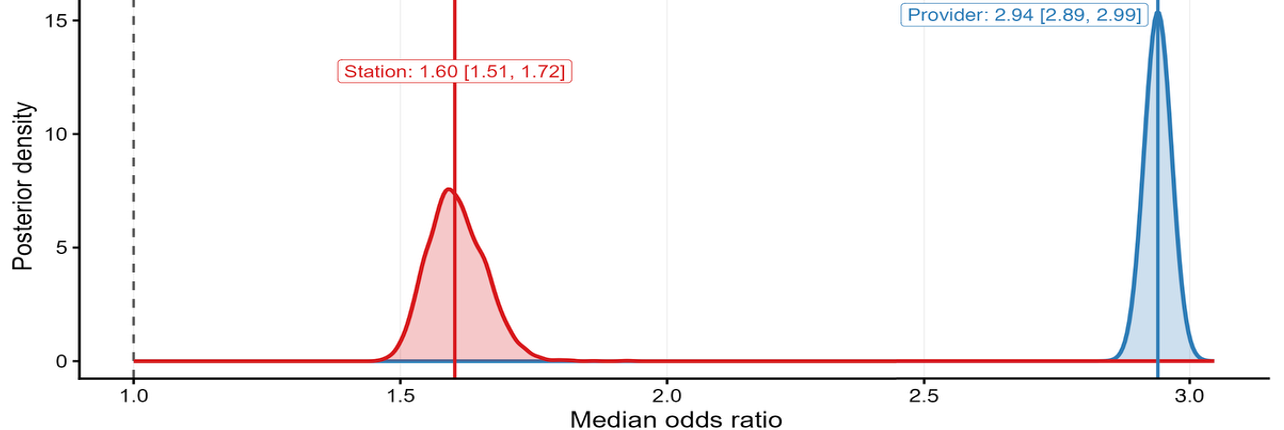
Christian Dalton and colleagues developed a workflow that combined diagnosis code information with natural language processing-derived SSTI subtypes to study prescribing patterns in VA outpatient care. They examined 415,653 non-purulent SSTI encounters from 2005–2018, involving 34,482 providers at 130 VA stations. The researchers accounted for patient demographics and severity, provider type, clinic type, setting, region, first visit, and calendar year with a Bayesian hierarchical logistic regression model. They found substantially more residual variation in anti-streptococcal antibiotic coverage between providers than between VA stations. Their results indicate that clinician-level decision-making may be an important target for focused decision support, audit and feedback, and education. The findings can help inform antibiotic-stewardship approaches while recognizing that prescribing variation alone does not establish whether care was appropriate for an individual patient.
Before moving the workflow into the VA Informatics and Computing Infrastructure (VINCI) to run on a GPU server, the researchers used systems at the Center for High Performance Computing to test the SSTI workflow and evaluate its handling of large datasets with synthetic data. CHPC systems and services provided a practical environment for validating the computational approach and assessing its scalability before analysis in the VA environment.